
PTA SIM Rules 2026
PTA SIM Rules 2026: If you are about to buy a new local connection in Pakistan, want to change ownership of an existing number, or simply wish to ensure that there are no foreign connections registered under your CNIC, the latest PTA SIM rules changes may be of particular interest to you.
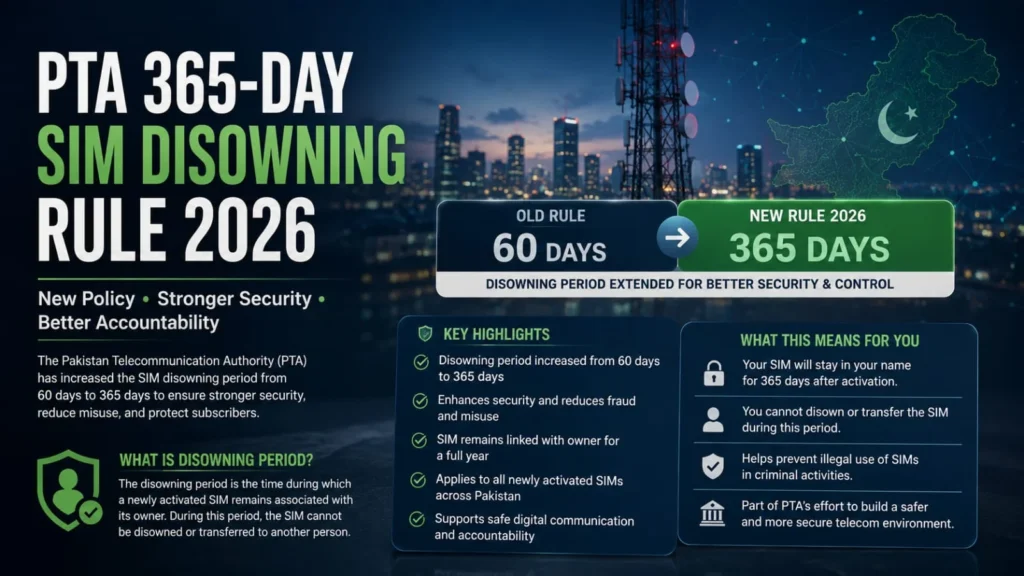
The most notable of them is the increase in the disowning period from 60 to 365 days, which the PTA authorities believe will have a positive effect on reducing illegal SIM issuance and unauthorized registration.
In addition to this official announcement, there are some other reasons why you should be aware of the changes. Firstly, any information regarding the SIM rules is often shared on social media, where it is easy to confuse one update for another or mistake an operator’s guideline for an official document.
This article aims to summarize the most important changes affecting ordinary users and separate them from the general list of SIM-card registration requirements. It also includes the information on how to check for existing connections registered under the CNIC and what to do if one discovers an unknown number.
Check: Sim Owner Details Pakistan
PTA SIM Rules 2026: What Has Actually Changed?
For most mobile users, the 365-day disowning period is the headline change.
Under the revised policy, a newly activated SIM cannot be disowned until one year after activation. PTA’s advisory was also accompanied by a warning that customers should be careful when providing biometric verification because the connection remains associated with their identity for a much longer period.
Other parts of the SIM system, such as subscriber verification and checking the numbers registered against a CNIC, remain important as well.
The key points at a glance
| PTA SIM rule / requirement | What it means for users |
| 365-day disowning period | A newly activated SIM cannot be disowned during the first year under the revised policy |
| Subscriber verification | SIM issuance must follow the prescribed identity-verification process |
| CNIC-linked ownership | The registered subscriber remains responsible for the connection |
| Illegal SIM issuance | SIMs issued without the required verification are prohibited |
| 668 checking | Users can check SIMs issued in their name and act on unauthorized connections |
| eSIM developments | PTA has introduced changes to the eSIM framework in 2026 |
| Official channels | Users should obtain SIMs through legitimate operator channels |
The distinction between a new rule and an existing requirement is important. Not everything mentioned in a 2026 SIM article is necessarily something PTA introduced this year.
What Is the New 365-Day SIM Rule?
The 365-day rule changes the disownment period of a newly activated SIM.
Previously, the disownment period was 60 days, however, PTA has decided to increase it to 365 days, thus the newly activated SIM will stay under your name for a year before it can be officially disowned through the regular process.
This might seem like an insignificant change, however, it bears a rather important practical application.
Think twice before registering anyone’s SIM
In case you ever encounter a situation where someone wants to register his/her mobile number on your CNIC (for whatever reason), the safest choice would be to refuse, as it could potentially cause you some trouble.
Even if the person is a close friend, relative or business contact, he/she might misuse it as his/her own number.
And if he/she does so, you will ultimately have to clarify why did you registered that particular number on your CNIC.
Therefore, the best course of action would be to not register anyone’s SIM card in your name for his/her exclusive use.
Why did PTA extend the period?
The stated objective is to strengthen safeguards against illegal SIM issuance and unauthorized registrations. PTA’s public advisory also urged consumers to be particularly careful while providing biometric verification for SIM issuance.
A longer retention period makes rapid registration-and-transfer activity more difficult and keeps the link between the subscriber and the connection more stable.
Does the 365-day rule mean a lost SIM cannot be blocked?
No.
Blocking and disowning are different things.
If your phone or SIM is lost or stolen, you should contact your operator and secure the number. The one-year disowning rule should not be confused with the procedure for protecting a compromised connection.
Why Biometric Verification Matters for SIM Registration
Biometric verification is a central part of Pakistan’s subscriber-registration system.
The purpose is straightforward: the person requesting a connection should be properly identified rather than allowing a SIM to be issued merely because someone knows another person’s CNIC number.
PTA’s National Telecom CERT specifically warns consumers about illegal SIM issuance and recommends buying SIMs through cellular franchises and checking the numbers issued in their names.
What makes biometric misuse dangerous?
Your fingerprint is not something you can replace like a password.
That is why users should be careful about where and why they provide biometric information.
PTA’s cybercrime guidance warns about illegal SIM issuance methods involving the collection or misuse of biometric information. It recommends using legitimate cellular-franchise channels instead of informal sales points.
Watch out for these situations
Be cautious if someone:
- asks to use your CNIC for a SIM they will personally use;
- offers a “pre-verified” SIM;
- promises activation without the normal verification process;
- asks for your fingerprint for an unclear reason;
- wants to register several connections without explaining why;
- tells you that checking your registered SIMs is unnecessary.
A legitimate registration process should make it clear what connection is being registered and who the subscriber is.
Read Also: Biometric SIM Verification in Pakistan: Complete Guide (2026)
Can You Buy a Pre-Verified SIM?
You should avoid it.
A pre-verified SIM creates a basic ownership problem: the person physically using the number may not be the person whose identity is recorded by the operator.
PTA’s cybersecurity guidance states that selling or providing a SIM without the required verification of subscriber credentials is illegal. It also advises consumers to purchase SIMs from cellular franchises rather than informal channels.
Why is a pre-verified SIM risky?
Imagine buying a number that is already registered against someone else’s CNIC.
You may be able to use it normally for a while, but the official subscriber remains someone else.
That can become especially problematic if:
- the number is lost;
- you need a replacement;
- the number is involved in a dispute;
- the registered owner reports it;
- the connection is used for fraudulent activity.
The small convenience of skipping proper registration is not worth creating an identity and ownership problem.
How Many SIMs Can You Have on One CNIC?
A commonly cited framework allows:
| SIM category | Maximum |
| Voice SIMs | 5 |
| Data SIMs | 3 |
| Total | 8 |
However, users should not assume that this automatically means they can obtain eight ordinary voice connections.
The distinction between voice and data SIMs matters.
If you have accumulated several old numbers over the years, it is better to check your CNIC record before applying for another connection. That can also reveal numbers you have forgotten about.
Read Also: SIM Limit Per CNIC in Pakistan: How Many SIMs Can You Register?
Why checking matters
People often remember the SIMs they currently use but forget older connections.
An unused number can remain associated with your identity even after you stop thinking about it.
That is why checking your CNIC-linked SIM information periodically is a useful security habit.
How to Check SIMs Registered Against Your CNIC
If you want to know how many SIMs are registered in your name, one established method is the 668 SIM check.
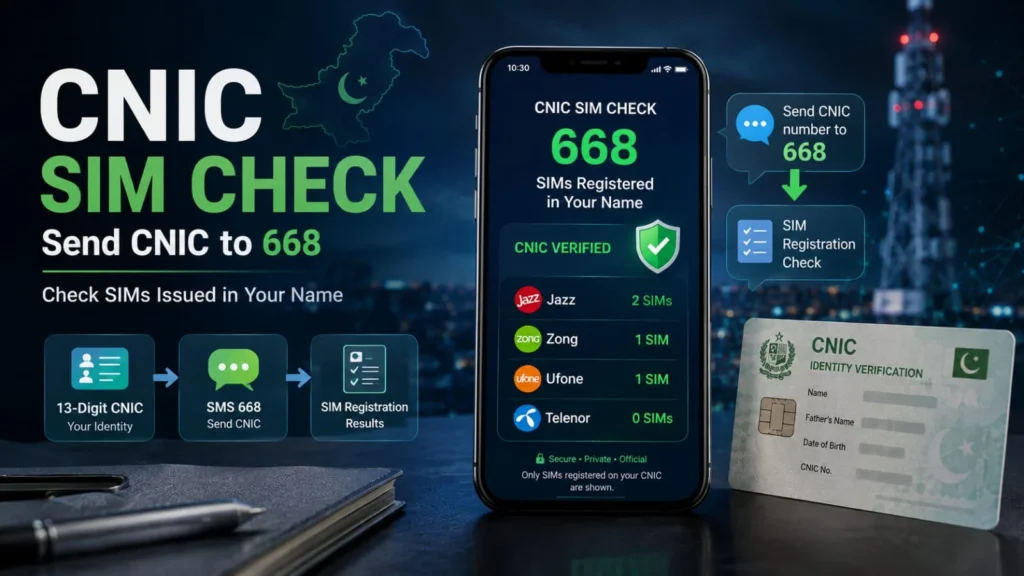
PTA’s cybersecurity guidance specifically instructs consumers to periodically check the SIMs issued in their name by sending their CNIC number to 668 and to block illegally issued connections.
How to check through 668
- Open the SMS application on your mobile phone.
- Enter your 13-digit CNIC number without dashes.
- Send the CNIC number to 668.
- Review the response.
- If you find a connection you do not recognize, contact the relevant operator.
For the latest online checking options, use the official PTA/SIM information channels rather than relying on unofficial websites that claim to provide private subscriber details.
Read Also: 667 SIM Check in Pakistan: 667 vs 668, MNP & SIM Verification
What does the check help you identify?
A CNIC SIM check can help you discover:
- old connections;
- numbers you no longer remember;
- unexpected registrations;
- possible unauthorized SIMs.
It is particularly useful if you have changed mobile networks several times or have registered SIMs for family or business purposes in the past.
Found an Unknown SIM on Your CNIC? Here’s What to Do
Finding a number you do not recognize does not automatically prove that someone committed fraud. First confirm the information and identify the operator.
Once you are sure the connection is unfamiliar, take action rather than leaving it unresolved.
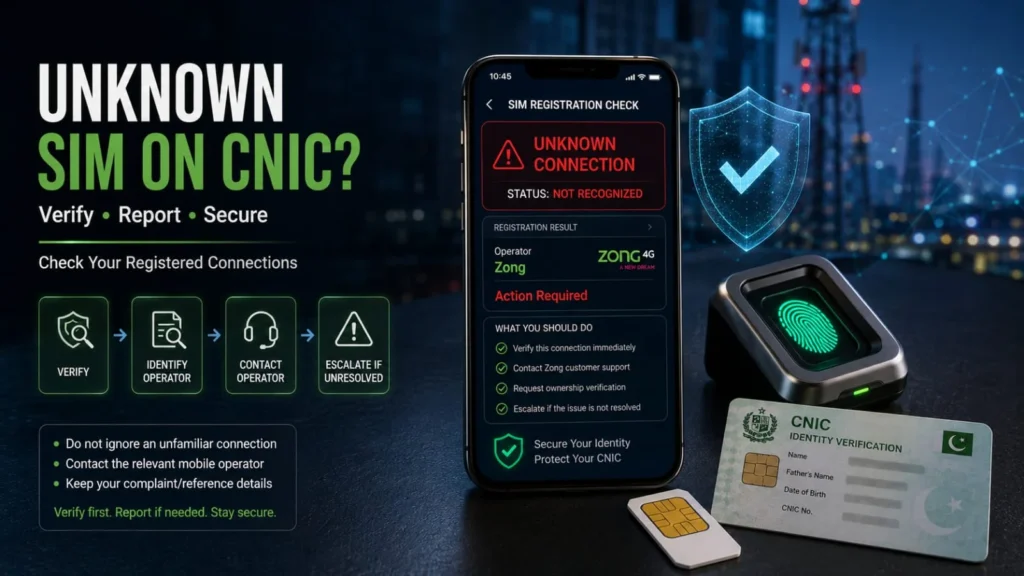
Now, go through the given steps to disable the SIM card registered on your CNIC:
Step 1: Verify SIM information
Double-check if the number appears against your CNIC.
Step 2: Discover the network operator
Ascertain whether it is Jazz, Zong, Ufone, or any other.
Step 3: Go to the network provider
Bring your original CNIC to an authorized customer care center and explain that you are not the owner of that particular connection.
Inquire about the process to block or get rid of it.
Step 4: Keep your complaint details
If you submit a complaint, keep the reference number or other record provided by the operator.
Step 5: Escalate if the issue remains unresolved
PTA’s Complaint Management System provides consumers with a way to register and track telecom complaints.
PTA’s own cybersecurity guidance also tells consumers to check the SIMs issued in their names and block illegally issued connections.
The key point is not to ignore an unknown SIM simply because you are not currently using that number.
Read Also: How to Trace Unknown Phone Numbers in Pakistan Safely
SIM Blocking vs Disowning vs Ownership Transfer
These terms sound similar but describe different things.
| Term | Meaning |
| Block | Stops a connection from being used |
| Disown | Removes a connection from your ownership |
| Ownership transfer | Changes the registered owner |
| Duplicate SIM | Replaces the SIM associated with an existing number |
| MNP | Transfers a mobile number to another network while keeping the number |
This distinction becomes particularly important when dealing with the 365-day rule.
For example, if your phone is stolen, your immediate concern is usually blocking and securing the number.
If you discover a SIM that was registered in your name without your knowledge, your concern is unauthorized ownership and identity misuse.
Those are different situations and should not be treated as the same request at a franchise.
PTA SIM Rules for Lost or Stolen SIMs
A lost SIM deserves quick attention because your mobile number may be connected to banking services, email accounts, WhatsApp, social media and other services that use SMS verification.
If the SIM disappears:
- Contact your mobile operator.
- Request that the lost connection be blocked.
- Ask about replacing the SIM while keeping the same number.
- Secure accounts that use the number for OTPs.
- Watch for unexpected login or verification messages.
PTA’s cybersecurity guidance also discusses SIM-swapping attacks and the risk of an attacker persuading a carrier to move a victim’s number to another SIM.
If your phone suddenly stops receiving calls and SMS without an obvious reason, contacting your operator quickly is sensible.
Read Also: How to Replace a Lost or Stolen SIM Card in Pakistan
What Is the Difference Between a Physical SIM and an eSIM?
An eSIM performs the same basic connectivity role as a traditional SIM, but the subscriber profile is stored electronically in a compatible device rather than on a removable plastic card.
This means you cannot simply take an eSIM out of one phone and place it into another.
The mobile operator has to handle the relevant profile transfer or re-issue process.
Jazz, for example, describes eSIM as an embedded SIM that allows compatible devices to activate a mobile number without inserting a physical SIM card.
Are eSIM users outside PTA’s SIM rules?
No.
The fact that the SIM is digital does not remove subscriber-identity requirements.
An eSIM still represents a mobile connection belonging to a subscriber, so the applicable registration and verification framework continues to matter.
What changed for eSIM in 2026?
PTA announced a revised eSIM pricing framework in August 2026. The competitor material you provided identifies August 17, 2026 as the effective date and cites a maximum initial fee of Rs. 1,500 with free transfer provisions.
Because pricing and transfer conditions can be operator-sensitive, users should confirm the exact charge and transfer procedure with their network before visiting a service centre.
Read Also: The Future of eSIM in Pakistan: Virtual SIM Registration, Activation & PTA Guide
What About SIMs on an Expired CNIC?
Your CNIC information is an important part of the subscriber record.
If your identity document has expired or your personal information needs updating, do not wait until a mobile service stops working before dealing with it.
The practical approach is to keep your identity documents current and contact the relevant operator if your subscriber information needs to be updated.
This is another reason to periodically review the SIMs connected to your identity instead of assuming that old registrations will disappear automatically.
Is It Legal to Sell a SIM Without Proper Verification?
No.
PTA’s cybersecurity material is explicit on this point: providing a SIM without obtaining and verifying the subscriber’s credentials in the prescribed manner is illegal. The guidance also describes unauthorized SIM issuance as a cybercrime-related risk and advises consumers to use legitimate cellular-franchise channels.
That makes offers such as these red flags:
- “Already biometric verified”
- “No fingerprint required”
- “SIM on another person’s CNIC”
- “Pre-activated SIM”
- “SIM without registration”
If you encounter such an offer, the safer choice is to walk away.
PTA SIM Rules 2026: Don’t Confuse Confirmed Changes With Rumors
This is where many SIM articles become misleading.
A post might say:
“PTA has changed the SIM limit.”
Another might claim:
“All old SIMs will be blocked.”
A third may announce a new fee without mentioning its effective date.
Before accepting any of these claims, ask five questions:
- Did PTA actually announce it?
- When does it take effect?
- Does it apply nationwide?
- Is it a new rule or an existing requirement?
- Does it apply to new SIMs, existing connections or a specific service?
The distinction is especially important for rules involving SIM limits, disowning, eSIM transfers and operator charges.
A good rule of thumb is to check the regulator’s announcement first and the operator’s current procedure second.
PTA SIM Rules for Jazz, Zong, Ufone and Other Networks
The basic subscriber-protection principles do not disappear when you change networks.
Whether your number is on Jazz, Zong, Ufone or another cellular operator, you should still make sure:
- the SIM is registered in your own name;
- the required verification process is completed;
- you are not using a pre-verified SIM;
- you know which connections are associated with your CNIC;
- lost or suspicious connections are reported promptly.
The exact customer-service process can vary between operators, particularly for eSIM activation, replacement, ownership-related requests and other services.
So when a question is operator-specific, check the current procedure directly with that network instead of assuming that every franchise follows an identical process.
Read Also: Jazz vs Zong vs Telenor vs Ufone: Which Network Is Best in Pakistan in 2026?
What Happens If Someone Uses Your CNIC for a SIM?
If you believe a connection was registered using your CNIC without your permission, treat it as an identity issue.
Start by checking the registration and identifying the operator.
Then report the connection to the operator and request the appropriate resolution.
PTA’s cybersecurity guidance specifically recommends that consumers periodically check the SIMs issued in their name and block illegally issued connections.
If the operator does not resolve the issue, PTA’s Complaint Management System can be used to submit and track a telecom complaint.
Keep complaint numbers, dates and relevant documents. They can be useful if you need to explain later that you reported an unauthorized connection.
A Simple PTA SIM Security Checklist
You do not need to follow complicated procedures every month.
A few basic habits are enough to reduce unnecessary risk.
- Register your own SIMs.
- Never lend your CNIC for someone else’s SIM registration.
- Avoid pre-verified SIM cards.
- Use legitimate operator channels.
- Be careful when providing biometric information.
- Check the SIMs associated with your CNIC.
- Report unfamiliar connections.
- Block lost or stolen SIMs quickly.
- Keep your CNIC information current.
- Verify major PTA announcements before acting on social-media posts.
These steps are consistent with PTA’s consumer cybersecurity guidance, which specifically recommends legitimate SIM purchasing channels and periodic checking of SIMs issued in a user’s name.
Frequently Asked Questions
What is the biggest PTA SIM rule change in 2026?
The most significant change for ordinary subscribers is the extension of the SIM disowning period from 60 days to 365 days. PTA said the move is intended to strengthen safeguards against illegal SIM issuance and unauthorized registrations.
What is the 365-day SIM rule in Pakistan?
Under the revised policy, a newly activated SIM cannot be disowned during the first 365 days after activation. This replaced the earlier 60-day period.
Can I register a SIM on my CNIC for another person?
You should not do so. The connection remains registered against your identity, even if another person is the one actually using it.
How can I check SIMs registered against my CNIC?
PTA’s cybersecurity guidance recommends sending your CNIC number to 668 to check the SIMs issued in your name.
What should I do if I find an unknown SIM?
Contact the relevant operator, report that the connection is not yours and ask for the appropriate blocking or ownership-resolution process. If necessary, escalate the matter through PTA’s complaint system.
Are pre-verified SIMs safe?
No. A pre-verified SIM may be registered under someone else’s identity, creating an ownership and security problem.
Is biometric verification required for SIM registration?
Subscriber verification is a core requirement of legitimate SIM issuance. PTA’s cybersecurity guidance specifically warns against SIM issuance without proper verification and advises users to obtain SIMs through legitimate cellular franchises.
What happens if my SIM is stolen?
Contact your mobile operator as soon as possible and request that the connection be secured or blocked. If you need to keep the number, ask about the replacement procedure.
Are eSIMs covered by PTA SIM rules?
Yes. An eSIM is simply a digital form of SIM technology. The fact that there is no removable plastic card does not remove the need for correct subscriber ownership and applicable verification.
What changed for eSIM users in 2026?
PTA introduced a revised eSIM framework in August 2026. The exact fee and transfer procedure should be confirmed with the relevant operator before requesting the service.
Can I transfer a newly activated SIM immediately?
The revised policy extends the normal disowning period for a newly activated SIM to 365 days, so you should not assume that a newly registered number can be transferred shortly after activation.
Why should I check my CNIC-linked SIMs?
Because an old or unauthorized connection can remain associated with your identity even when you are no longer using it. PTA’s cybersecurity guidance specifically recommends periodic checking.
Where should I buy a new SIM?
Use a legitimate cellular operator channel, such as an authorized franchise or customer-service outlet. PTA’s cybersecurity guidance specifically advises consumers to purchase SIMs through cellular franchises rather than informal channels.
Conclusion
The main lesson behind the PTA SIM Rules 2026 is not complicated: a SIM registered against your CNIC should actually belong to you and remain under your control.
The move from a 60-day to a 365-day disowning period makes that point even more important. PTA’s stated objective is to strengthen safeguards against illegal SIM issuance and unauthorized registrations.
For most users, the safest routine is straightforward. Register your own connections, use legitimate operator channels, be careful with biometric verification, avoid pre-verified SIMs and check which numbers are associated with your CNIC.
If you discover an unfamiliar connection, do not simply ignore it. Contact the operator, keep your complaint details and use PTA’s complaint mechanism if the matter is not resolved.
And when you see a new “PTA SIM rule” circulating online, check the source before changing anything. Telecom policies can be updated, but an old Facebook post or forwarded WhatsApp message is not the same thing as an official regulatory announcement.
For the latest changes, verify the applicable rule with PTA and your mobile operator before taking action.