
667 SIM Check in Pakistan: 667 vs 668, MNP & SIM Verification
If you want to check a SIM in Pakistan, it is essential to know the crucial difference between 667 and 668. Both are related to SIM services but have different functionality.
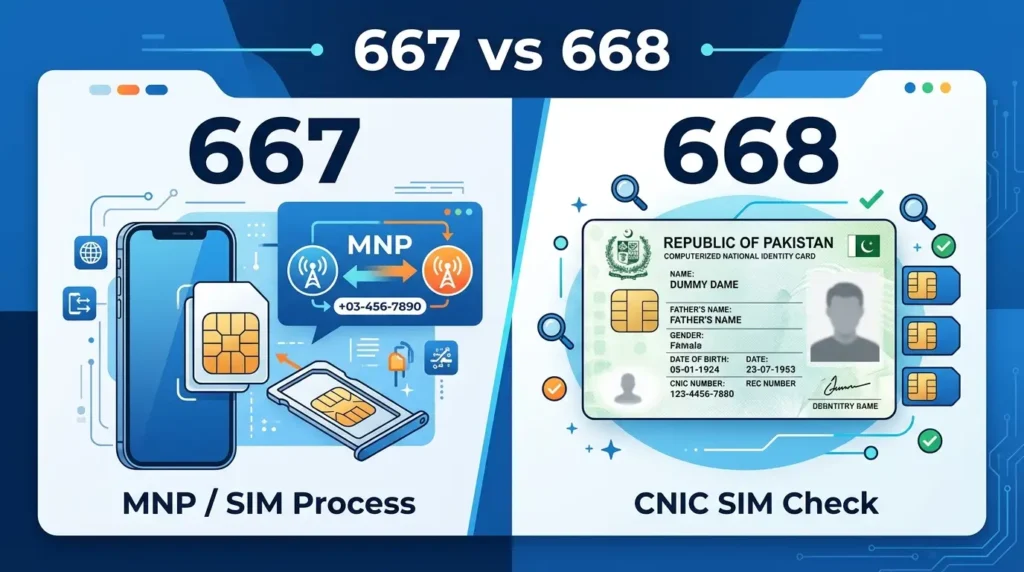
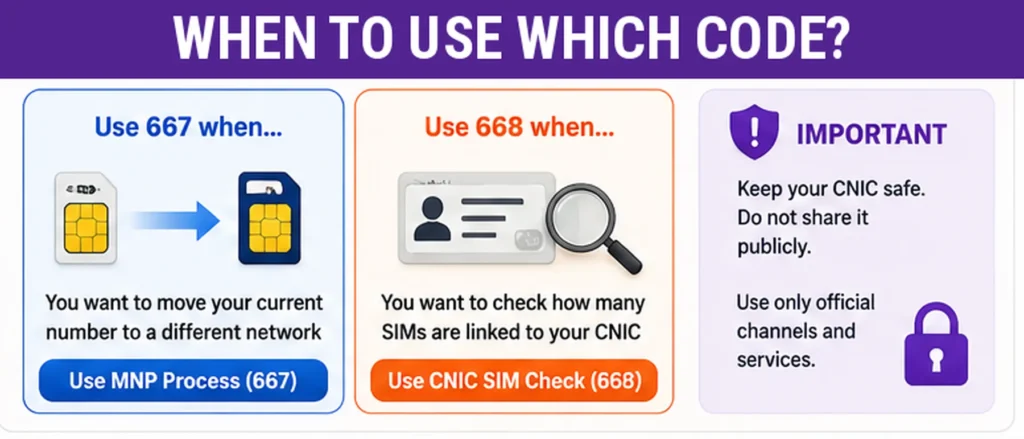
667 is related to the Mobile Number Portability (MNP) process, whereas 668 is used to check how many SIMs are issued against your CNIC.
More: Check SIM on CNIC
According to FIA’s cyber-crime safety guide published via PTA’s NTCERT, checking the number of SIMs against CNIC can be done by dialing 668, which provides a list of numbers issued under your name. This guide provides details about how the 667 SIM check works, what to text to 667, what response to expect, the difference between 667 and 668, and what to do if a texted SIM’s ownership does not match your information.
What Is the 667 SIM Check?
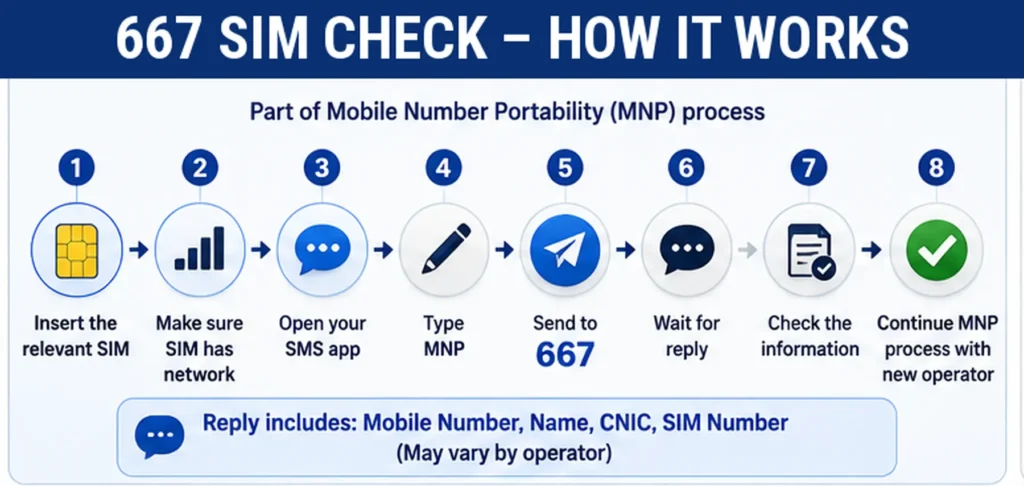
The 667 SIM check is part of the Mobile Number Portability process in Pakistan.
For an MNP request, the relevant mobile connection can be used to send:
SMS: MNP
Send to: 667
For example, Ufone’s published MNP instructions currently state that customers should write MNP and send it to 667. Ufone says the reply contains the mobile number, name, CNIC, and SIM number, after which the customer can forward the received SMS as part of its MNP procedure.
Quick 667 Summary
| Detail | 667 |
| SMS | MNP |
| Short code | 667 |
| Main purpose | MNP-related verification |
| Used from | Relevant mobile connection |
| General number lookup | No |
| Typical use | Number porting |
Important: MNP procedures can vary by operator. Always follow the current instructions provided by the network to which you are porting your number.
How to Use the 667 SIM Check
If your operator’s current MNP procedure requires 667, follow these steps:
- Insert the relevant SIM into your phone.
- Make sure the SIM has network service.
- Open your SMS application.
- Create a new SMS.
- Type MNP.
- Send it to 667.
- Wait for the automated reply.
- Check the information returned.
- Continue the MNP process through the receiving operator’s official channel.
For Ufone’s current published procedure, the reply includes the mobile number, subscriber name, CNIC, and SIM number, and Ufone instructs customers to forward that SMS to 76333 to complete its MNP request process.
Example
Message: MNP
Number: 667
The important thing is to send the request from the SIM involved in the MNP process, rather than treating 667 as a website where you can enter any random mobile number.
What Does the 667 Reply Mean?
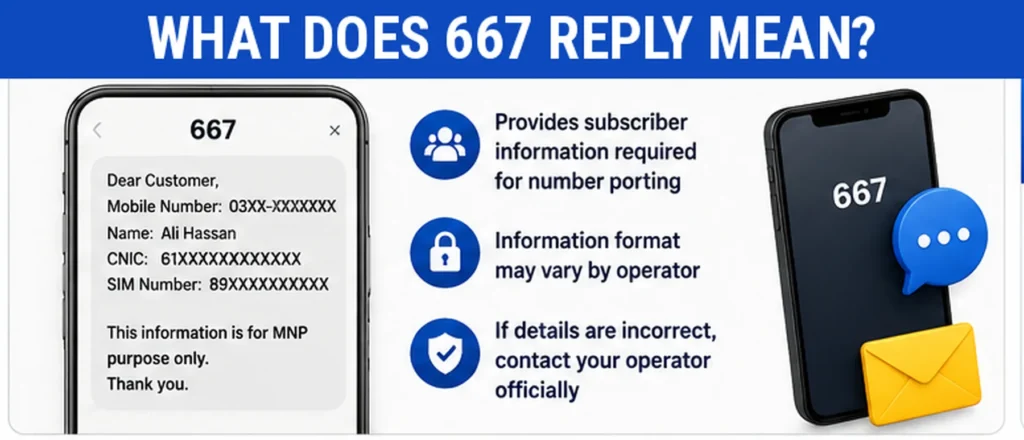
The 667 response is used as part of the MNP process to provide subscriber-related information needed for porting.
For example, Ufone’s published instructions specify that its MNP response contains:
- Mobile number
- Subscriber name
- CNIC
- SIM number
The information is then used in the operator’s subsequent MNP process.
Because operator procedures can differ, don’t assume that every network will use the same follow-up steps or message format.
If the information returned does not match your records, stop and contact your operator through an official channel rather than relying on an unofficial SIM database.
667 vs 668: What’s the Difference?
This is the easiest way to understand the two services:
667 → MNP-related verification
668 → CNIC-level SIM check
FIA’s cyber-crime safety guidance, published through PTA’s NTCERT resources, recommends periodically checking the number of SIMs issued in your name through 668 and taking action against illegally issued SIMs.
| Check | 667 | 668 |
| Main purpose | MNP-related verification | CNIC-based SIM check |
| Focus | SIM involved in MNP | SIMs registered in your name |
| Typical request | MNP | CNIC information |
| Common use | Number porting | Personal SIM audit |
| General owner lookup | No | No |
Which One Should You Use?
If you’re asking:
“I want to move my current mobile number to a different network.”
More: Transfer SIM Ownership Online in Pakistan
Use the MNP procedure, including 667 when your operator requires it.
If you’re asking:
“How many mobile SIMs are linked to my CNIC?”
Use the 668-based CNIC SIM check.
So, 667 and 668 are not interchangeable.
What Is 668 Used For?
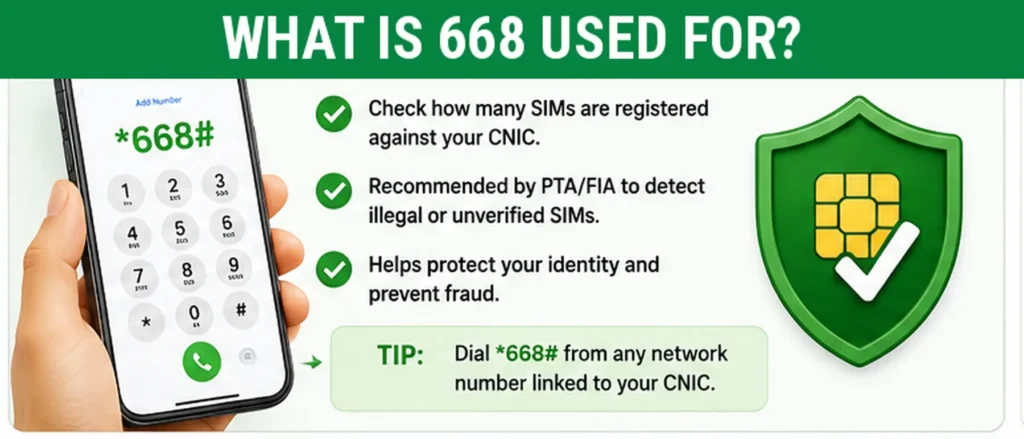
- The 668 service is used for checking SIMs associated with your CNIC.
- This makes it particularly useful for a personal SIM-registration audit.
- PTA/FIA guidance advises consumers to periodically check the number of SIMs issued in their name through 668 and to take steps to block illegally issued SIMs.
- If you find a connection that you don’t recognize, contact the relevant mobile operator through an authorized channel and ask about the proper process for investigation or disowning.
Why Should You Check Your SIM Before Porting?
Mobile Number Portability allows you to change your mobile network while keeping your existing number.
Before starting an MNP request, make sure:
- The SIM is active.
- The subscriber information matches your records.
- Your CNIC information is available.
- You understand the receiving operator’s MNP procedure.
- You complete any required biometric or identity verification.
- You use an official operator channel.
This can help prevent delays if there is an issue with the SIM’s registration information.
Can 667 Check Any Mobile Number?
No.
667 should not be treated as a general-purpose reverse lookup service.
You cannot simply take another person’s mobile number, send it to 667, and expect the service to reveal that person’s private subscriber information.
The 667 process is connected to MNP and the mobile connection being used for that process.
Be especially cautious with websites or individuals claiming that they can reveal complete private SIM-owner information from a mobile number.
More: Check SIM Owner Detail Pakistan
Can You Find the Owner of a Random SIM Number?
You should not rely on unofficial services to obtain another person’s private subscriber information.
If you need information about your own SIM, use the relevant operator’s official procedure.
If you discover a SIM registered against your CNIC that you don’t recognize, contact the operator and use the appropriate official complaint or disowning process.
PTA also provides a formal complaint-management system for telecom complaints.
What If 667 Doesn’t Reply?
If you send MNP to 667 and don’t receive the expected response, try these steps:
1. Check the SMS
Make sure you sent:
MNP → 667
2. Check Network Service
Make sure the SIM is connected to the network and can send SMS.
3. Wait a Little
A temporary network or short-code issue can sometimes delay an automated response.
4. Check Your Operator’s Current MNP Instructions
MNP procedures may change, and operators can have different follow-up requirements.
5. Contact Your Operator
If the issue continues, contact the network’s official customer-support service.
6. Visit an Authorized Franchise
For registration, ownership, biometric, or SIM-related problems, an authorized franchise may be the appropriate place to resolve the issue.
Found an Old SIM? Here’s What to Do
If you find an old SIM in a drawer, don’t automatically assume that it is still active or registered to you.
Instead:
- Put the SIM in a compatible phone.
- Check whether it connects to the network.
- Determine whether the number is actually yours.
- Check your CNIC-level SIM registrations if necessary.
- Contact the operator if the ownership or registration is unclear.
Possessing a physical SIM card does not by itself establish that you are the registered subscriber.
What About a SIM in a Used Phone?
If you buy a second-hand phone and discover a SIM inside it, don’t assume the SIM belongs to you.
The SIM may belong to the previous owner.
Before using it:
- Check whether it is active.
- Determine whether it is yours.
- Remove it if you don’t need it.
- Don’t attempt to obtain the previous owner’s private information.
- Contact the relevant operator if you need clarification.
Using a SIM that is registered to someone else can create unnecessary ownership and security problems. Jazz, for example, states in its customer terms that using a SIM not in your name or allowing others to use your SIM is a crime under PTA rules.
What If an Unknown SIM Appears on Your CNIC?
If your 668 check shows a SIM that you don’t recognize, don’t ignore it.
More: Block Unauthorized SIM Online in Pakistan
Contact the relevant mobile operator through an official customer-service channel or authorized franchise and explain that the connection does not appear to belong to you.
Ask about the appropriate procedure for:
- verifying the registration,
- investigating the connection, or
- disowning/blocking it where applicable.
FIA’s cyber-crime safety guidance, published through PTA’s NTCERT resources, advises consumers to check SIMs issued in their name and take action against illegally issued SIMs.
Never Share These Details With Unofficial SIM Agents
If someone claims they can “verify” or “remove” a SIM for you, don’t casually share sensitive information.
Never give an unknown person:
- CNIC details
- OTPs
- passwords
- biometric information
- SIM replacement codes
- account credentials
Use official operator channels instead.
Common 667 & 668 Myths
Myth 1: 667 Can Check Any Number
False.
667 is associated with the MNP process, not unrestricted mobile-number reverse lookup.
Myth 2: 667 and 668 Are the Same
False.
667 is associated with MNP-related processing, while 668 is used for checking SIMs associated with your CNIC.
Myth 3: Whoever Has the Physical SIM Owns It
Not necessarily.
The registered subscriber is determined through the operator’s subscriber records and verification process.
Myth 4: Third-Party SIM Databases Are Official
No.
Unofficial websites and databases are not substitutes for official telecom verification.
Myth 5: An Old SIM Is Automatically Disconnected
Don’t assume it.
If you no longer use a SIM, verify its status and registration rather than assuming it has automatically been disconnected.
667 SIM Check Before MNP: Quick Checklist
- Make sure the relevant SIM is active.
- Send MNP to 667 when required by your operator’s current MNP procedure.
- Review the SMS response carefully.
- Confirm that the subscriber information matches your records.
- Keep your original CNIC available.
- Follow the receiving operator’s official MNP procedure.
- Complete required biometric or identity verification.
- Don’t share OTPs or biometric information with unofficial agents.
Frequently Asked Questions
What is the 667 code used for in Pakistan?
667 is associated with the Mobile Number Portability (MNP) process. For example, Ufone’s published MNP procedure instructs customers to send MNP to 667 from the relevant SIM and then use the response in the next step of its porting process.
What is the 668 code used for?
668 is used for checking SIMs registered against your CNIC. FIA’s cyber-crime safety guidance, published through PTA’s NTCERT resources, recommends periodically checking the SIMs issued in your name through 668.
Can I check another person’s SIM through 667?
No. 667 should not be treated as a general method for obtaining another person’s private subscriber information.
Should I use 667 before porting my number?
If your operator’s current MNP procedure requires it, yes. Follow the operator’s official instructions because the steps after the 667 response can vary.
What information can the 667 response contain?
The exact response depends on the operator. Ufone’s published procedure says its response contains the mobile number, name, CNIC, and SIM number.
What should I do if the 667 information doesn’t match my records?
Contact the relevant mobile operator through an official channel. Don’t use unofficial websites to obtain private subscriber information.
What should I do if an unknown SIM appears against my CNIC?
Contact the relevant operator and ask about the official process for investigation or disowning the connection.
What if I find an old SIM that I no longer use?
Don’t assume that it is automatically disconnected. Check its status and CNIC registration and contact the operator if you need to deactivate or disown it.
Can I use a third-party website to check a SIM owner?
It’s best not to rely on unofficial websites claiming to reveal private subscriber information. Use official telecom and operator channels for SIM verification.
Final Verdict: 667 or 668?
The difference is simple:
667 → MNP-related SIM verification
Use 667 when it is part of your operator’s Mobile Number Portability procedure. For example, Ufone currently instructs customers to send MNP to 667 and use the returned information in its porting process.
668 → CNIC-level SIM check
Use 668 when you want to review SIMs associated with your CNIC. FIA’s cyber-crime safety guidance, published through PTA’s NTCERT resources, specifically recommends this as a way to identify SIMs issued in your name.
So if you’re dealing with MNP, think 667.
If you’re auditing the SIMs registered in your name, think 668.
Most importantly, use official operator/PTA channels for registration and ownership issues, and never share sensitive information such as your CNIC details, OTPs, passwords, or biometric information with unofficial agents.