
PTA Fines Jazz, Zong, Telenor & Ufone Rs 740 Million Over Illegal SIM Issuance
PTA Fines Telecom Operators: The Pakistan Telecommunication Authority (PTA) has imposed cumulative penalties of approximately Rs 740 million on Pakistan’s four major mobile operators—Jazz, Zong, Telenor Pakistan and Ufone—over reported violations involving SIM issuance, subscriber verification, biometric controls and franchise oversight.
Read Also: How to Block Unauthorized SIM Online in Pakistan
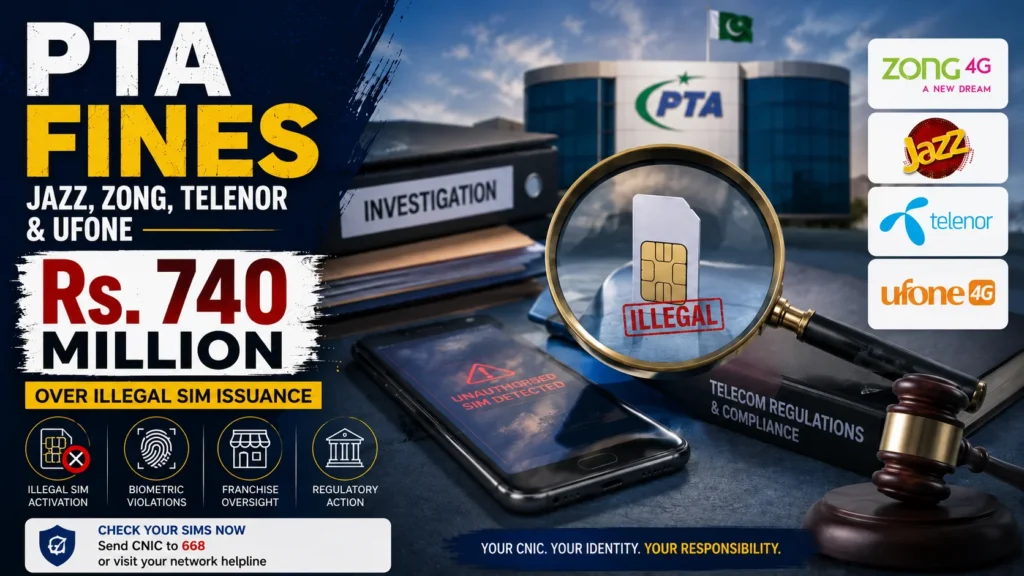
The enforcement action is significant for mobile users because some SIMs were reportedly activated against citizens’ CNICs without their knowledge, consent or physical presence at the relevant outlet. PTA also identified weaknesses involving franchise monitoring, biometric verification, Live Finger Detection and location controls.
For consumers, the biggest takeaway is simple: check the SIMs registered against your CNIC regularly and report any connection you do not recognize through official channels.
Check Now: Sim Owner Details Pakistan
Quick Answer: Why Did PTA Fine Jazz, Zong, Telenor and Ufone?
PTA’s enforcement action focused on violations related to SIM registration, customer consent, biometric verification, franchise supervision and other regulatory controls.
The reported penalties were:
| Mobile Operator | Reported Penalty | Main Issue |
| Zong | Rs 155.6 million | SIM issuance violations |
| Jazz | Rs 116.7 million | SIM issuance and supervision issues |
| Telenor Pakistan | Rs 116.7 million | SIM registration violations |
| Ufone | More than Rs 233.4 million | Multiple regulatory violations |
| Combined | About Rs 740 million | Multiple SIM-related violations |
Ufone received the largest cumulative penalty. Its reported penalties included Rs 116.7 million, Rs 77.8 million and Rs 38.9 million, totaling approximately Rs 233.4 million.
The operators were directed to deposit the penalties within the stipulated period, with further legal action possible in case of non-compliance.
Why Did PTA Fine the Four Mobile Operators?
According to the enforcement reporting covered in this article, PTA examined whether mobile operators were properly following the rules governing SIM issuance and subscriber verification.
The reported violations included:
- SIMs activated without genuine customer consent
- Connections issued without the subscriber being physically present
- Weak monitoring of authorized franchises
- Problems with biometric verification procedures
- Inadequate controls over biometric equipment
- Weak implementation of Live Finger Detection
- Gaps in geofencing and location controls
PTA’s enforcement action was taken under Section 23 of the Pakistan Telecommunication (Re-organization) Act, 1996. The regulator held operators responsible for compliance across their authorized distribution networks.
What Does the PTA SIM Penalty Mean for Mobile Users?
The issue is important because a SIM registered against your CNIC can be connected to your identity even if you did not personally request it.
An unauthorized connection may potentially create risks involving:
- Identity-related fraud
- Financial scams
- Fraudulent calls and messages
- Unauthorized account registrations
- Cybercrime
- Misuse of telecom services
This does not mean that every unfamiliar SIM is automatically being used for criminal activity. However, an unfamiliar connection should be investigated through the relevant mobile operator.
PTA cybersecurity guidance also encourages consumers to periodically check the number of SIMs issued in their name and take action when they discover an illegally issued connection.
Zong Case: SIM Activated Through a Lahore Franchise
One of the enforcement cases involved China Mobile Pakistan, the operator behind Zong.
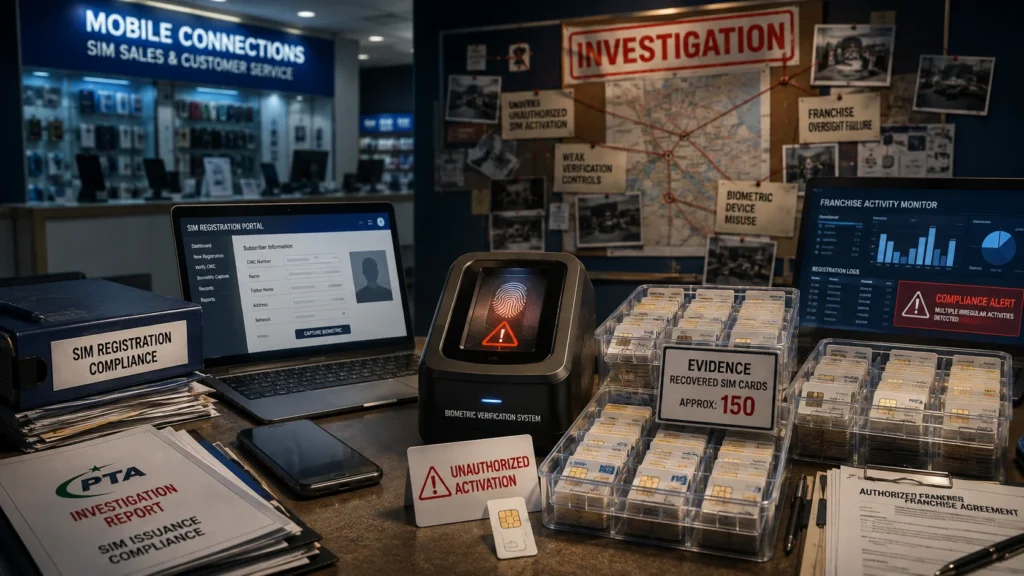
According to the reported enforcement findings, a SIM was activated against a subscriber’s CNIC through an authorized Zong franchise in Lahore even though the subscriber was reportedly unaware of the activation.
During a subsequent raid, authorities recovered equipment including:
- Laptops
- Biometric verification devices
- Approximately 150 SIM cards
The case highlights an important point about SIM registration: a biometric verification step by itself does not necessarily establish that every part of the SIM issuance process was compliant.
A properly controlled SIM registration process also requires:
- Genuine subscriber consent
- Correct identity verification
- Proper use of biometric equipment
- Location controls
- Franchise monitoring
- Appropriate record keeping
Telenor Pakistan Was Also Penalized
Telenor Pakistan faced a reported Rs 116.7 million penalty in the enforcement action.
The reported case involved a SIM activated against a subscriber’s CNIC without the customer’s consent. The investigation also involved an authorized franchise and biometric verification equipment.
The enforcement action reinforces the importance of monitoring authorized sales outlets. Operators are expected to maintain effective compliance controls across their distribution networks rather than relying solely on the presence of biometric equipment.
Why Was Jazz Fined?
Jazz was issued a reported Rs 116.7 million penalty.
The enforcement action involved reported violations associated with SIM issuance and supervision of the operator’s sales network.
PTA’s concerns included compliance with subscriber verification requirements and the controls used at authorized outlets.
The wider lesson for telecom operators is that biometric verification must operate as part of a broader compliance system that includes customer authorization, proper procedures and effective franchise oversight.
Ufone Faced the Largest Cumulative Penalty
Ufone received the largest cumulative penalty among the four operators.
The reported penalties included:
- Rs 116.7 million
- Rs 77.8 million
- Rs 38.9 million
Together, these amount to approximately Rs 233.4 million.
Separate enforcement reporting also highlighted the recovery of thousands of SIMs during the crackdown.
The reported figures included:
- 12,636 Ufone SIMs
- 1,370 Jazz SIMs
- 1,100 Zong SIMs
- 890 Telenor SIMs
Biometric devices and other equipment were also reportedly recovered.
These figures demonstrate why SIM-registration enforcement can involve more than individual activations. Effective controls also need to cover the wider network of franchises, biometric equipment and distribution channels.
What Went Wrong With SIM Verification?
The reported enforcement findings point to several areas where SIM registration controls can become vulnerable.
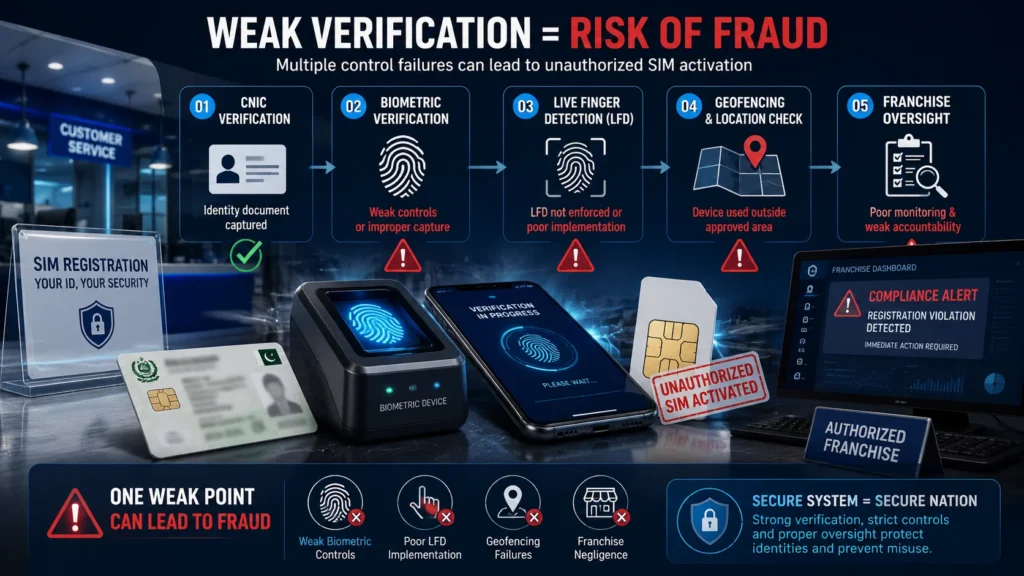
1. Weak Live Finger Detection
Live Finger Detection (LFD) is intended to help determine whether a fingerprint being presented comes from a live finger rather than a reproduced or manipulated fingerprint.
PTA identified shortcomings relating to the implementation of this safeguard in the cases under investigation.
2. Gaps in Geofencing
Geofencing can help restrict biometric verification devices to approved locations.
Reported shortcomings in geofencing controls raised concerns about how verification equipment could be monitored and used outside expected locations.
3. Inadequate Franchise Monitoring
Authorized franchises are an important part of mobile operators’ distribution networks.
The enforcement action highlights why operators need effective controls over how their authorized outlets issue and register SIMs.
A franchise should not become a regulatory blind spot.
4. Lack of Genuine Customer Consent
For consumers, one of the most important reported issues was the activation of SIMs without the knowledge or authorization of the CNIC holder.
This can be particularly concerning because an affected person may not discover an unauthorized connection until much later.
Raed Also: Biometric SIM Verification in Pakistan: Complete Guide (2026)
How to Check SIMs Registered on Your CNIC
If you are concerned that an unknown SIM may have been registered using your CNIC, you can check the connections associated with your identity.
Method 1: Check Through 668
You can use the PTA SIM information service by sending your 13-digit CNIC number without dashes to 668.
The service can provide information about the number of SIMs associated with your CNIC across mobile operators.
Checking your registered SIMs periodically can help you identify connections that you do not recognize.
Method 2: Use the PTA Online SIM Information System
You can also check your SIM registration information through the official PTA SIM Information System.
When dealing with sensitive identity information, always make sure you are using an official PTA service.
Never enter your CNIC number into an unknown website that claims to provide private SIM-owner information or unauthorized personal records.
Important: Checking SIMs registered against your own CNIC is different from trying to obtain another person’s private subscriber information.
Read Also: How to Find all Mobile Numbers Registered on Your CNIC Pakistan 2026
What If You Find an Unknown SIM on Your CNIC?
If your CNIC-linked SIM information shows a connection you do not recognize, do not ignore it.
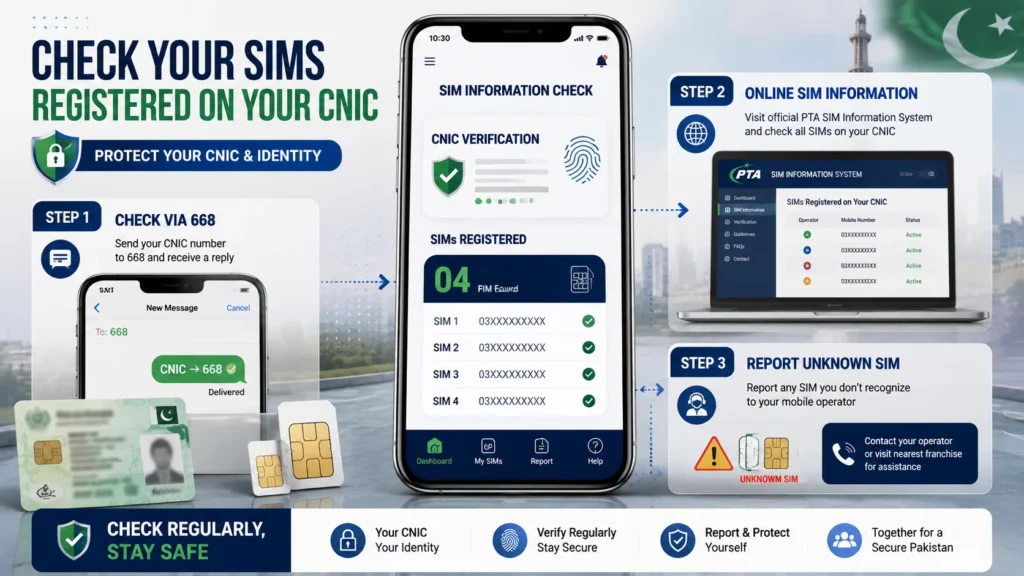
Follow these steps:
- Identify the mobile operator associated with the connection.
- Visit the operator’s official customer service center or authorized franchise.
- Take your original CNIC with you.
- Explain that you do not recognize or authorize the connection.
- Ask the operator to investigate the registration.
- Request disowning or removal of the unauthorized connection where applicable.
- Keep any complaint or service reference number provided to you.
- Recheck your CNIC-linked SIM information after the issue has been processed.
- If the matter remains unresolved, escalate it through the official PTA complaint process.
PTA cybersecurity guidance also recommends taking action to block illegally issued SIMs after identifying them.
Read Also: How to Trace Unknown Phone Numbers in Pakistan Safely
Do Not Use Unofficial SIM Owner Websites
There is an important difference between checking how many SIMs are registered against your own CNIC and trying to obtain someone else’s private subscriber information.
Avoid websites, social-media accounts or individuals claiming that they can provide:
- Private SIM-owner records
- CNIC databases
- Personal addresses
- Private subscriber details
- Leaked telecom records
These claims can put your own personal information at risk.
For your own SIM registration status, use official PTA and telecom operator channels and avoid entering your CNIC information into untrusted services.
What Happens If Operators Do Not Comply With PTA’s Orders?
The affected operators were directed to deposit the reported penalties within the specified period.
PTA warned that further legal action could follow if an operator failed to comply with the relevant order.
The enforcement action also sends a broader message to Pakistan’s telecom industry: operators are expected to maintain effective compliance systems throughout their authorized sales and franchise networks.
What Does PTA’s Rs 740 Million Action Mean for Mobile Users?
For ordinary mobile users, the most important takeaway is:
Do not automatically assume that every SIM registered against your CNIC was activated by you.
If you have:
- Used multiple mobile networks
- Replaced old SIMs
- Lost a SIM in the past
- Changed mobile numbers
- Had your CNIC used during telecom transactions
it is sensible to periodically check your registered connections.
If you find an unfamiliar connection, contact the relevant operator through an official channel and request verification.
At the same time, an unfamiliar SIM does not automatically prove criminal activity. The correct approach is to have the registration investigated and request removal or disowning where appropriate.
Why Biometric Verification Alone Is Not Enough
One of the key lessons from the reported enforcement cases is that SIM security involves multiple layers.
A secure registration process can be viewed as:
Identity Verification → Customer Consent → Biometric Verification → Live Finger Detection → Location Controls → Franchise Monitoring → Regulatory Oversight
If one or more of these controls are weak, the overall SIM-registration process can become vulnerable.
This is why telecom compliance extends beyond simply scanning a customer’s fingerprint.
What Should You Do Today?
If you have not checked the SIMs associated with your CNIC recently, consider doing so through an official PTA channel.
A simple check can help you:
- Identify unfamiliar connections
- Contact the correct mobile operator
- Request investigation of unauthorized registrations
- Keep your CNIC-linked telecom information under control
You should also avoid unofficial websites offering private SIM-owner or CNIC information.
Frequently Asked Questions
Why did PTA fine Jazz, Zong, Telenor and Ufone?
PTA imposed penalties following reported violations involving SIM issuance, subscriber verification, biometric controls and supervision of authorized franchise networks. Some SIMs were reportedly activated against CNICs without the knowledge or consent of the individuals concerned.
How much did PTA fine the four operators?
The reported cumulative penalties across Jazz, Zong, Telenor Pakistan and Ufone were approximately Rs 740 million.
Which operator received the largest cumulative penalty?
Ufone received the largest cumulative penalty, with reported penalties totaling approximately Rs 233.4 million across multiple enforcement actions.
How much was Zong fined?
Zong was fined a reported Rs 155.6 million.
How much were Jazz and Telenor fined?
Jazz and Telenor Pakistan each received a reported penalty of Rs 116.7 million.
Can biometric verification alone guarantee that a SIM was issued legally?
No. Biometric verification is one part of the SIM registration process. Operators also need to ensure compliance with applicable verification requirements, customer authorization and other controls.
How can I check SIMs registered on my CNIC?
You can check CNIC registered SIM information via PTA SIM information service, i.e. through 668 SMS facility or through PTA online SIM Information System.
What should I do if I find some unknown SIM against my CNIC?
Report the issue to the relevant mobile operator through their customer care centers or authorized franchise. Bring your original CNIC along with you as a proof of ownership and ask them to screen the particular SIM. In case they are not aware about the connection between the SIM and your CNIC, they must verify and deown the same.
Why is it important to get rid of such unauthorized SIM?
An unauthorized SIM may be misused for identity theft, fraudulent activities, financial or cyber crime, or any other unlawful activity. Hence all such SIMs must be probed for their connection with the consumer.
What happens if operators do not respond to the penalty imposed by PTA?
PTA has warned that in case the defaulting operators remain unresponsive to the penalty notice, further legal action would be taken against them.
Conclusion
PTA’s reported approximately Rs 740 million in penalties against Jazz, Zong, Telenor Pakistan and Ufone highlights the importance of strong SIM-registration controls, franchise monitoring, biometric safeguards and genuine customer consent.
The reported cases also show why a biometric scan should not be viewed as the entire security solution. Effective SIM registration requires multiple safeguards, including proper identity verification, customer authorization, Live Finger Detection, location controls and franchise oversight.