
Pakistan 5G: SIM Verification, Security and Fraud Risks in 2026
5G has started in Pakistan, and many people have questions about what it means for their SIM and personal security. Do you need a new SIM? Will rules of verification change? Does 5G make SIM fraud more likely?
The answer is very simple: 5G does not make a SIM less secure or easier to hack itself. The main concern is still control of the mobile number. A phone number can be linked to WhatsApp, banking, email recovery, and other accounts. So, unauthorized changes can cause serious problems.
Quick Answer: Does 5G Change SIM Verification?
Not in any fundamental way.
Using 5G does not remove the need to identify the person using a mobile number. SIM registration and identity checks are still important.
NADRA provides identity-verification services used by authorized organizations, which include biometric and facial – recognition-based verification. These systems help confirm that the identity information of a person matches their CNIC. (nadra.gov.pk)
There is no simple rule like “5G means new SIM verification”.
The network is changing itself. Keeping your mobile identity secure becomes more important when more people and devices rely on mobile connectivity.
What Are the Changes Pakistan Has Made Concerning 5G?
Upon completing the spectrum auction process, Pakistan progressed in its development toward 5G implementation in 2026. It will not be launched nationwide at once; instead, it will occur progressively.
There are numerous benefits to the users, which include improved connection speed and capacity and reduced latency.
Its not mean that 5G creates a new type of SIM fraud.
It means that mobile networks are becoming more capable, while the phone number remains an important part of the digital lives of many people.
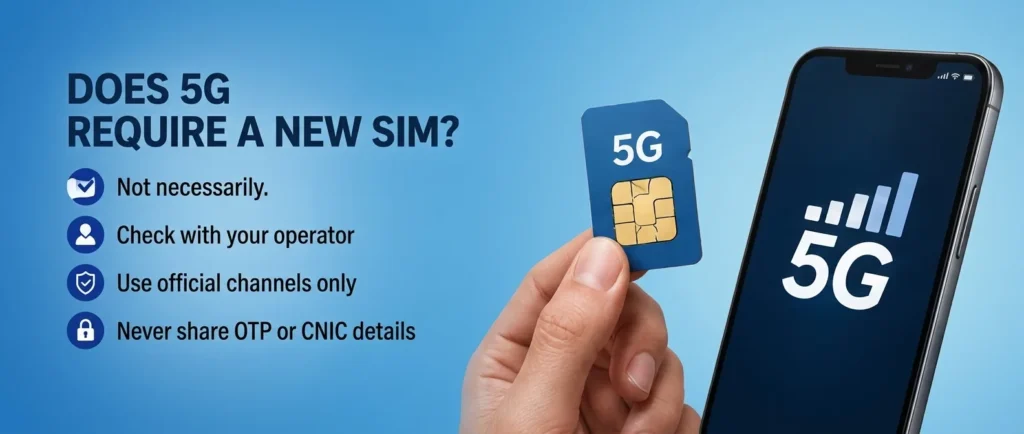
Does 5G Require a New SIM?
Not necessarily.
Whether you need a replacement depends on your operator, your current SIM, your phone, and the 5G service available in your area.
You should use an official outlet or customer service channel when your operator tells you that your SIM needs replacement. Don’t reply to a random WhatsApp message, phone calls, or social media account that offers a “5G upgrade”.
Scammers can use a genuine-looking upgrade story to ask for your CNIC number, OTP, or other personal information.
You should not share your banking PIN or an OTP with anyone because they just claim to help you to activate 5G.
More:The Future of eSIM in Pakistan: Virtual SIM Registration, Activation & PTA Guide
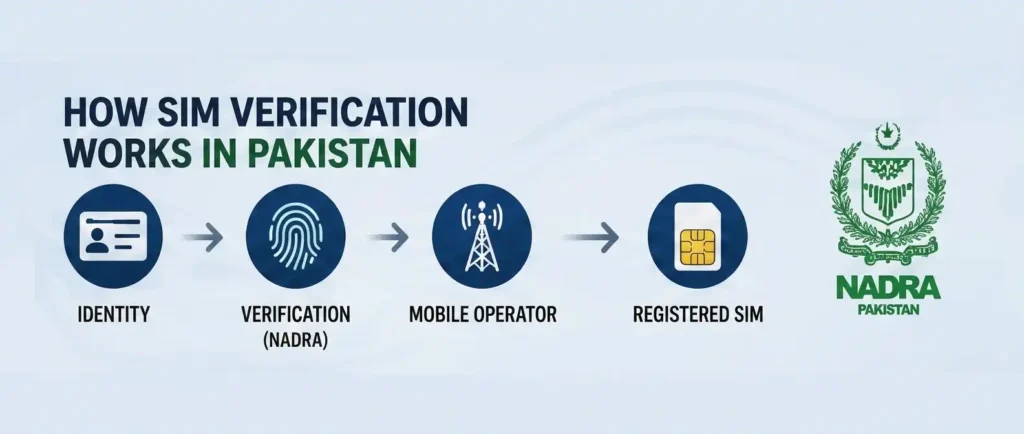
How SIM Verification Works in Pakistan
The basic idea is easy to understand.
When a SIM is registered, the subscriber’s identity needs to be verified and connected with the mobile operator’s records. NADRA provides identity-verification services that can be used by authorized organizations. Its depend on situation that whwther verification involves fingerprint, photograph, or facial recognition. (nadra.gov.pk)
A simple way to look at it is:
Identity → verification → mobile operator → registered SIM
The actual technical process is more detailed than this, but the purpose is the same: make sure a mobile number is associated with a properly identified subscriber. eSIM Owner Details in Pakistan
NADRA’s registration and biometric policy framework also recognizes SIM verification as an important part of the wider identity system. (nadra.gov.pk)
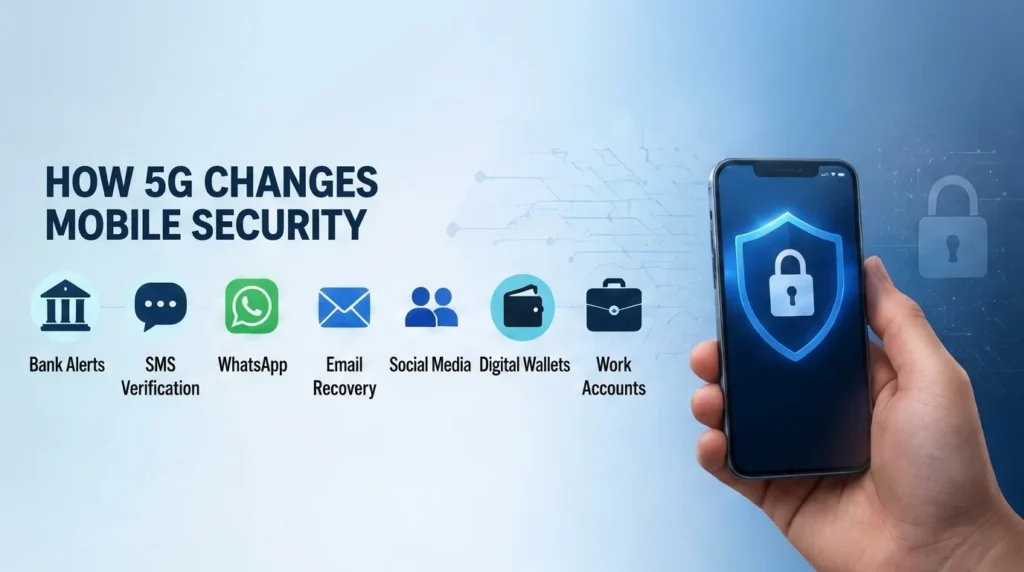
How 5G Changes Mobile Security
There is a common misunderstanding here.
A 5G connection does not give someone a way to take over your SIM. Network speed and SIM ownership are two different things.
The concern is what people use their phone numbers for.
Your number might be connected to:
- Bank alerts
- SMS verification
- Email recovery
- Social media
- Digital wallets
- Work accounts
If somebody gets control of the number, they may try to use that access against other accounts.
That risk present before 5G and will continue to remain after it.
Does 5G Increase SIM-Swap Fraud?
There is no good reason to say that 5G itself makes SIM swapping easier.
A SIM swap happens when someone manages to get a replacement SIM connected to another person’s number. This can involve identity theft, fraudulent requests, or weaknesses in the SIM replacement process.
The important part is the unauthorized change of control.
It does not matter whether the original customer normally used 4G or 5G.
What may matter more in the future is how many services depend on that mobile number.
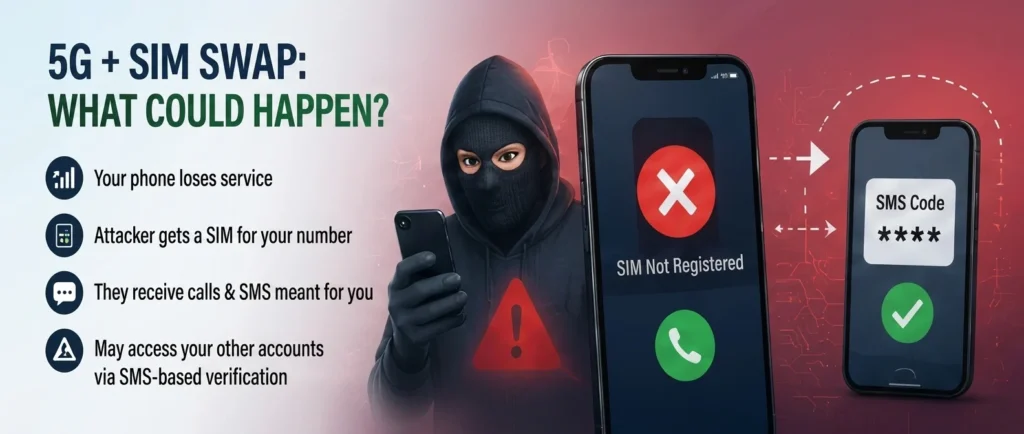
5G + SIM Swap: What Could Happen?
Suppose your phone stops showing any service.
You do not have a new SIM card, but some other person gets a replacement SIM card for your number.
Then they can get any calls or SMS that are being sent to you. If you use your number for recovery of other services or SMS-based authentication, then an attacker could use this to log in to other services of yours.
That does not mean they will automatically get into your bank account or WhatsApp. Other security checks may stop them.
Still, an unexpected loss of mobile service should not be ignored.
If it happens without an obvious reason, contact your operator and find out what happened.
More:SIM Card Not Working? 17 Causes & Quick Fixes
Biometric Verification vs Facial Verification
Fingerprint verification has been used for years as part of Pakistan’s SIM registration system.
It is useful, but fingerprints are not always easy to capture or verify. Some people have difficulty completing the process because of their physical work, age, or other practical reasons.
That is one reason alternative verification methods matter.
NADRA now provides verification services that include facial recognition and other biometric options for authorized organizations (nadra.gov.pk)
The idea is not that facial verification will magically eliminate fraud. It gives authorized organizations another way to confirm someone’s identity when the normal process is difficult or unsuitable.
Biggest SIM Fraud Risks in 2026
| Risk | What it means |
| Unauthorized SIM | A number is registered or issued without the owner’s permission |
| SIM swap | An existing number is moved to another SIM |
| Stolen CNIC details | Personal information is used to impersonate someone |
| Fake 5G offers | A scammer uses a network upgrade as a reason to request information |
| Illegal SIM sales | SIMs are sold without proper verification |
| OTP theft | An attacker with access to a number may try to receive SMS codes |
| Account recovery abuse | A phone number is used to try to regain access to another account |
These problems are not all new. The reason they still matter is that a mobile number can open the door to other services when it is used as a recovery or verification method.
How to Check Your SIM Security
The first thing to check is which SIMs are registered against your CNIC.
More:PTA SIM Limit: How Many SIMs Can One CNIC Have?
Use the official PTA-supported method rather than giving your CNIC information to a third-party website or someone on social media.
If the result shows a number you do not recognize, contact the relevant mobile operator and ask what needs to be done.
It is also a good time to review the accounts that use your phone number. Check your banking, email and messaging accounts and make sure their security settings are up to date.
What to Do If You Find an Unknown SIM
Don’t leave it for later.
- Find out which operator the number belongs to.
- Contact that operator through an official channel.
- Explain that you did not register or request the SIM.
- Ask what steps are needed to block or remove it.
- Check important accounts linked to your number.
- Keep any messages, receipts, or other information related to the incident.
- Make a formal complaint if you believe fraud has taken place.
Acting quickly can limit what someone can do with an unauthorized number. Block Unauthorized SIM Online in Pakistan
5G Security Risks for Mobile Banking & OTPs
5G does not make a bank account unsafe.
The problem is that many services still use a mobile number as one part of the login, verification,n or recovery process.
If someone takes control of your number, they might try to receive SMS codes or use the number during account recovery.
That is why an OTP should always be treated as private. Your bank, mobile operator, or another legitimate company should not need you to read an OTP to them over the phone.
If your bank offers app-based approval, an authenticator, or another security method, it can be worth enabling it.
5G Security Risks for WhatsApp & Account Recovery
WhatsApp and other services can also depend heavily on the phone number.
If an attacker gets control of your number, they can try to register it on another device. Two-step verification can provide another layer of protection.
The same applies to email and social media accounts.
If your phone number is the only way to recover an important account, losing that number can make the situation much harder to fix.
5G, IoT and Future Identity Risks
5G is not only about faster phones.
The technology can support more connected equipment, including sensors, industrial systems, vehicles and other devices.
That brings a different security question: how do companies know which device is allowed to connect, and who is allowed to use it?
Not every connected device will use a traditional consumer SIM, and not every device creates a fraud risk. But as more equipment becomes connected, identity and access controls will matter more.
For users, this is a longer-term issue rather than an immediate reason to worry.
5G SIM Security: Myths vs Reality
Myth: 5G makes SIMs easier to hack.
Reality: Simply connecting to a 5G network does not make a SIM easier to compromise.
Myth: Everyone needs a new SIM for 5G.
Reality: It depends on the operator, device, SIM, and local service availability.
Myth: Biometric verification makes SIM fraud impossible.
Reality: It makes unauthorized registration harder, but no verification system removes every possible risk.
Myth: 5G automatically means better security.
Reality: Network performance and personal account security are separate things.
Myth: A message offering a 5G upgrade is genuine because it mentions your operator.
Reality: Anyone can copy a company’s name or logo. Check the offer yourself through an official channel.
2026 Pakistan SIM Security Checklist
- Check the SIMs registered against your CNIC.
- Report any number you don’t recognize.
- Don’t share OTPs, passwords, or banking PINs.
- Don’t give biometric information to unknown people.
- Be careful with unexpected 5G or SIM-upgrade messages.
- Use official outlets for SIM replacement.
- Turn on two-step verification for important accounts.
- Keep account recovery details current.
- Contact your operator if your SIM suddenly stops working.
- Use official PTA channels for telecom complaints.
Conclusion
5G changes the way Pakistan connects to the internet. It does not suddenly change how criminals can steal a SIM.
The basic precautions remain the ones that are most important; the ones about knowing which SIMs are registered under your name, keeping your CNIC safe, not revealing OTPs, and addressing issues with unexpected SIM changes right away.
As various services become reliant on mobile, it becomes more important to keep control of your numbers, not that 5G makes it somehow insecure by default, but the number itself can be valuable.
FAQs
Does 5G change SIM registration in Pakistan?
No. The move to 5G does not remove the need for subscriber identification and SIM verification.
Does 5G increase SIM-swap fraud?
Not directly. SIM swapping is mainly related to identity verification and control of a mobile number.
Do I need a new SIM for 5G?
Not necessarily. Check with your operator to see whether your existing SIM, phone, and plan support the service.
How can I check the SIMs registered to my CNIC?
Use the official PTA-supported SIM information service. Avoid giving your CNIC details to unofficial websites or individuals.
What should I do if my SIM suddenly stops working?
Make contact with your mobile operator immediately and ask if a replacement SIM or other change has been requested against the number.
Can biometric verification stop every type of SIM fraud?
No, it is an important measure of security, but it does not always guarantee that every type of fraud will be secured.