
What to Do If Your Pak SIM Data Is Leaked or Misused
Your mobile number is not just a communication tool anymore. In Pakistan, a SIM card is connected to almost everything in digital life ranging from online banking to social media and government services. If your SIM registration details or CNIC number is misused, criminals can use it for financial fraud, creating fake accounts, phishing, and other malicious activities.
Identity theft is becoming a serious threat as more and more activities are being digitalized. A single illegal SIM registration can cause serious financial and legal issues if not dealt with. The same applies to CNIC misuse. Therefore every individual mobile user must check their SIMs registration and investigate any suspicious activity.
Whether your identity is being misused through a data leak or someone illegally registering a SIM against your information, you must take action before it is too late. This guide will explain exactly what to do if your CNIC is being misused. How to spot any suspicious activity related to your SIM registration and what to do to secure your digital life against identity theft.
Read More: How to Reactivate a Blocked SIM Card: Complete Guide 2026
Quick Answer: What Should You Do If Your SIM Data Is Leaked?
If you believe that your information (SIM) or CNIC has been compromised in any way, here is a list of things you should do:
- Check all SIMs registered against your CNIC.
- Look out for any mobile numbers that you do not recognize.
- Contact the particular networks you suspect.
- Visit a customer service center for verification through biometric means, if required.
- Ask for deactivation of unauthorized SIM cards.
- Change your passwords for important accounts.
- Turn on 2FA (Two-Factor Authentication)
- Report incidents to authorities if you suspect any sort of misuse
Monitor your bank, social media or any other accounts and mobile numbers for any suspicious activity.
Why SIM Data Leaks Are Dangerous
A leaked mobile number or a CNIC record is not as harmless as it seems. A lot of online services require a cell phone number for sign-up. Hence, getting access to your mobile number can enable a number of different attacks, not limited to just phone fraud.
Some of these are stated below:
- Unauthorized SIM registration
- Identity theft
- Fake social media accounts
- Banking and Wallet fraud
- Phishing calls and messages
- Abuse of account recovery options
- Unauthorized verification via OTP
- Attempts to commit financial fraud
Fraudsters might also combine social engineering with the leaked information to extract sensitive information from you as well. It is vital to stay alert and mitigate any such attempts as soon as you realize them, as most of these attacks can turn out to be way more damaging than they might seem.
How SIM Data Gets Leaked in Pakistan
Understanding how personal information is exposed helps you reduce future risks. In many cases, data leaks occur because sensitive documents are shared carelessly or handled without proper security measures.
Some common causes include:
Misuse of CNIC Copies
By providing photocopied or clear scans of your CNIC card to unknown persons or unreliable entities offering services, you allow them to use copies of your personal information. Any person who has obtained a copy of your CNIC can use it to commit fraud on telecom networks by impersonating you in verification processes.
Fake SIM Registration Agents
Certain dishonest individuals or entities may pose as SIM registration agents and acquire personal information from clients. Therefore, customers should deal only with the company’s official registration agents when activating or registering SIM cards.
Data Breach
Private corporations or organizations can suffer data breaches, resulting in customer information being leaked or stolen. A data leak can contain customer phone numbers or CNIC information, which fraudsters can use to impersonate the victim.
Scams
Fraudsters may contact you via phone calls or SMS and attempt to acquire personal information or OTPs from you. In many cases, scam artists impersonate organizations and send deceptive messages or calls.
Lost Documents
If your CNIC card or any other important documents are lost or stolen, they can be misused by criminals to impersonate the victim. It is critical that you check all of your registered phones for CNIC-related spam or SMS.
Common Signs That Your Identity May Be Misused
Identity fraud rarely occurs without giving an apparent warning. It is essential to double-check your account activity when you see something that seems odd to avoid adverse outcomes.
The following warning signs are a clear indication of identity theft, and you should check your account at the earliest convenience if you notice one or more of the following:
- Unrecognized SIM card(s) linked to your CNIC
- Unexpected SMS or call from any organization or individual
- Unexpected calls or SMS about an account that you did not open
- Unexpected banking SMS or alert about a transfer or deposit that you did not authorize
- Unexpected mobile wallet notifications
- Friends receive unwanted SMS or calls on your behalf claiming to be you
- Your phone loses network signal coverage for absolutely no reason
- Unwanted calls or SMS about password reset
Even you see one of these signs, double-check your account activity rather than dismissing it as a technical problem.
Quick Comparison: Normal Activity vs Suspicious Activity
| Normal Activity | Suspicious Activity |
| You receive OTP after requesting login | OTP arrives without any login attempt |
| SIM works normally every day | SIM suddenly stops working unexpectedly |
| Banking notifications match your transactions | Alerts appear for unknown transactions |
| Only your own SIMs are registered | Unknown SIMs appear against your CNIC |
| Social media logins are recognized | Login alerts from unknown devices or locations |
This comparison can help you quickly identify whether unusual activity requires immediate investigation.
Why Immediate Action Matters
Many users do not immediately report unauthorized registration of their SIM card since they believe that the situation will resolve on its own. However, such complacency may give fraudsters enough opportunities to exploit the security vulnerability.
- Therefore, it is essential to take prompt action to
- avoid further unauthorized registration of one’s SIM cards,
- prevent financial fraud,
- protect online accounts,
- establish an official trail,
- and
- eliminate potential future issues.
Indeed, the faster a user takes action, the fewer adverse effects may occur. Checking one’s registered SIM cards and accounts may prevent substantial damages and complications in the long run.
Step 1: Check SIMs Registered Against Your CNIC
The first and foremost step towards detecting misuse of your identity is to check how many SIM cards are registered against your CNIC. This will help you identify if any unknown number is active against your identity.
Pakistan Telecommunication Authority offers various ways to check how many SIM cards are registered against your CNIC.
After checking your registered SIM cards:
- Cross check the results with your own SIMs
- Write down all the unknown mobile numbers
- Find out from which company those unauthorized SIM cards have been issued.
- Do not miss even a single unauthorized connection.
Pro Tip: Make it a habit to check your registered SIM cards every few months or whenever you lose your CNIC or submits your identity documents for any official purpose.
Step 2: Identify the Mobile Network
Before requesting deactivation, determine which telecom operator issued the unauthorized SIM.
The SIM may belong to:
- Jazz
- Zong
- Telenor
- Ufone
- Onic (where applicable)
Knowing the correct operator helps you contact the appropriate customer support team and speeds up the verification process.
Step 3: Contact the Mobile Operator Immediately
Once you identify the operator, report the issue without unnecessary delay.
When speaking with customer support:
- Explain that the SIM is not yours.
- Request account verification.
- Ask for guidance on the official SIM blocking procedure.
- Record the complaint or reference number provided by the representative.
Keeping a complaint reference can be useful if further verification becomes necessary.
Step 4: Visit an Official Customer Service Center
Most unauthorized SIM cases require an in-person visit because telecom companies must verify the identity of the CNIC holder before making changes.
Take the following items with you:
- Original CNIC
- Complaint reference number (if available)
- Any supporting documents related to the complaint
During your visit, the representative may:
- Verify your identity.
- Perform biometric verification.
- Display the SIMs registered against your CNIC.
- Remove unauthorized connections after successful verification.
- Provide confirmation once the request is processed.
Always ask for written confirmation or a service receipt before leaving.
Step 5: Secure Every Account Linked to Your Mobile Number
Many online services use your mobile number for password recovery and account verification. If your SIM information has been exposed, your online accounts may also be at risk.
Immediately review:
- Email accounts
- Social media profiles
- Banking applications
- Mobile wallets
- Shopping accounts
- Cloud storage services
Update passwords and verify that recovery information has not been changed without your knowledge.
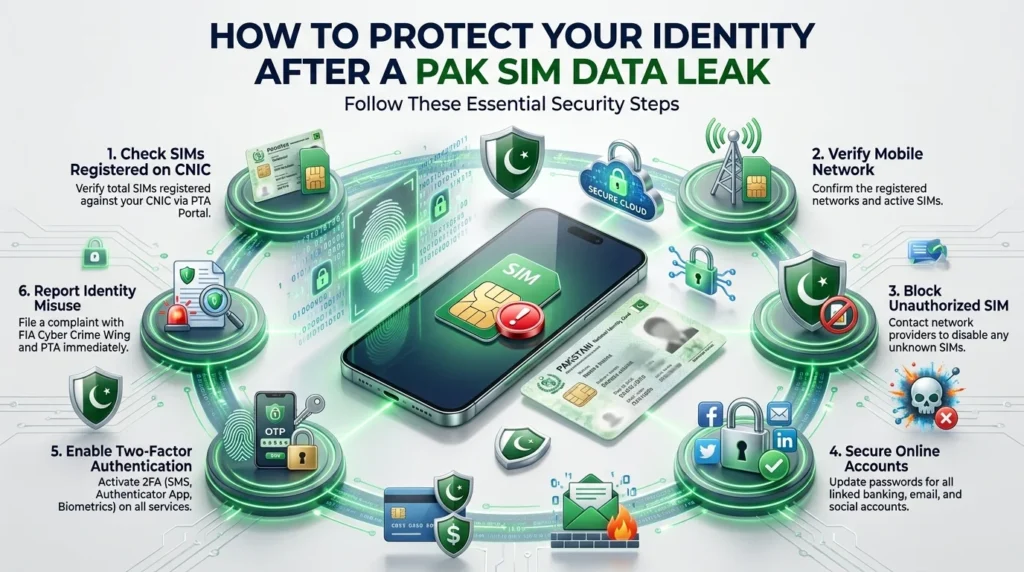
Enable Two-Factor Authentication (2FA)
Two-factor authentication adds an extra security layer.
Whenever possible:
- Use an authenticator application.
- Save backup recovery codes securely.
- Remove unknown trusted devices.
- Review recent login history.
This helps protect your accounts even if someone learns your password.
Reporting Identity Misuse
If you believe your identity has already been used for fraud, document everything before filing a complaint.
Helpful evidence includes:
- Screenshots
- SMS notifications
- Complaint reference numbers
- Account activity logs
- Banking alerts
- Dates and times of suspicious activity
Maintaining organized records makes it easier to explain the situation if additional verification is requested.
PTA and FIA: Understanding Their Roles
Many users confuse the responsibilities of different authorities.
The table below explains their general roles.
| Organization | Primary Responsibility |
| PTA | Telecom regulation, SIM registration oversight, and public verification services. |
| FIA Cyber Crime Wing | Investigation of cybercrime, online fraud, identity misuse, and digital offenses. |
| Mobile Network Operators | SIM issuance, customer verification, biometric confirmation, and SIM deactivation requests. |
Understanding these responsibilities helps you contact the right organization for your specific issue.
Emergency Identity Protection Checklist
Use this checklist if you suspect your information has been compromised.
- Verify SIMs registered against your CNIC.
- Identify unauthorized numbers.
- Contact the relevant telecom operator.
- Visit the official customer service center.
- Complete biometric verification if requested.
- Request removal of unauthorized SIMs.
- Change passwords for important accounts.
- Enable two-factor authentication.
- Review banking activity.
- Save complaint records and receipts.
Completing these steps promptly reduces the likelihood of additional misuse.
What To Do Immediately
If you suspect identity misuse, prioritize the following actions:
Do
- Verify all registered SIMs.
- Secure your email account first.
- Update banking passwords.
- Monitor mobile wallet activity.
- Enable security features on important accounts.
- Keep official complaint records.
- Stay alert for unusual account notifications.
Fast action can significantly reduce the impact of identity fraud.
What NOT To Do
Avoid making these common mistakes:
- Don’t ignore unexpected OTP messages.
- Don’t share verification codes.
- Don’t delay reporting suspicious activity.
- Don’t post CNIC images on social media.
- Don’t trust unofficial SIM registration agents.
- Don’t discard complaint receipts.
- Don’t assume an unknown SIM will disappear automatically.
Ignoring early warning signs can allow fraudsters more time to misuse your identity.
How to Protect Your CNIC
Your CNIC is one of your most important identity documents.
Follow these safety practices:
- Share CNIC copies only when necessary.
- Add a clear purpose watermark on photocopies.
- Store digital copies securely.
- Avoid sending unprotected CNIC images through messaging apps.
- Shred unnecessary photocopies instead of throwing them away.
These habits reduce the chances of document misuse.
Practical Security Tips for Everyday Users
Good cybersecurity habits can often be your best defense.
Here are some examples of good cybersecurity habits.
- Use a pin or fingerprint on your phone
- Make sure your operating system is always up to date
- Only download apps from a trusted source
- Never use public wifi
- Check your accounts for any suspicious activity
- And, make sure you’re not signed into devices you no longer have access to.
- Preventing attacks can be as simple as a few good habits.
Can You Recover After Identity Misuse?
Yes. In many situations, early reporting and prompt verification can help limit the impact of unauthorized SIM registration or identity misuse.
Recovery may involve:
- Removing unauthorized SIMs.
- Securing online accounts.
- Updating passwords.
- Monitoring financial activity.
- Keeping records of all complaints and verification requests.
Although recovery may take time depending on the circumstances, acting quickly generally leads to a better outcome.
Protect Your Banking and Digital Wallet Accounts
Many people use their mobile phones as a means to connect their banking and digital wallet services. Hence, anyone who has access to your SIM card or managed to clone your number may change your password or even withdraw money using OTP-based authorization.
Once your SIM card is registered and secured, check all your financial accounts related to the phone number.
It is essential to take the following steps:
- Change banking password (if possible).
- Change SIM card PIN (if possible).
- Check the account balance and transaction history.
- Activate transaction alerts.
- Remove devices linked to your account that you are no longer using.
- Immediately contact the bank if you detect any fraudulent transactions.
Always remember to react responsibly if you receive unsolicited banking messages. Even if you think that a particular transaction amount is small, never ignore it.
Protect Your WhatsApp and Social Media Accounts
Your phone number is also used to verify messaging and social media accounts. If an attacker gains access to your SIM, these accounts could become vulnerable.
To improve security:
- Enable two-step verification on WhatsApp.
- Update passwords for Facebook, Instagram, X, and other social platforms.
- Review active login sessions.
- Remove unknown devices.
- Verify your recovery email address.
- Never share verification codes with anyone.
Keeping these accounts secure helps prevent impersonation and unauthorized access.
Understanding SIM Swap Fraud
SIM swap fraud occurs when someone illegally transfers your mobile number to another SIM card. Once activated, they may receive your OTPs, verification messages, and password reset codes.
Common Warning Signs
- Your phone suddenly shows No Service.
- You stop receiving calls or SMS messages unexpectedly.
- Password reset notifications appear without your request.
- Friends report receiving unusual messages from your accounts.
- Banking verification codes stop arriving on your device.
If these signs appear, contact your mobile operator immediately and verify whether any SIM replacement request has been processed.
Long-Term Identity Protection Strategy
Protecting your identity should become part of your regular digital security routine.
Consider following this monthly checklist:
| Task | Recommended Frequency |
| Check SIMs registered on your CNIC | Every 2–3 months |
| Review banking transactions | Weekly |
| Update important passwords | Every 3–6 months |
| Review social media login sessions | Monthly |
| Check recovery phone numbers and email | Monthly |
| Update device software | As updates become available |
Regular monitoring allows you to detect suspicious activity before it develops into a larger security problem.
Best Practices for Protecting Personal Information
Developing safe digital habits is one of the most effective ways to reduce the risk of identity misuse.
Follow these recommendations:
- Keep your CNIC in a secure location.
- Avoid sharing personal information with unknown callers.
- Verify websites before entering sensitive details.
- Download applications only from trusted sources.
- Use unique passwords for different accounts.
- Enable biometric protection whenever available.
- Lock your phone with a secure PIN or fingerprint.
- Regularly review privacy settings on online accounts.
Small improvements in everyday security can greatly reduce your exposure to fraud.
Common Myths About SIM Data Leaks
Many misconceptions cause people to delay taking action.
Myth 1: Only bank customers are targeted.
Fact: Anyone with an active mobile number can become a target.
Myth 2: A leaked phone number is harmless.
Fact: Your mobile number may be linked to banking, email, and account recovery services.
Myth 3: Checking SIM registrations once is enough.
Fact: Periodic checks help identify unauthorized activity sooner.
Myth 4: Fraud only happens after losing a CNIC.
Fact: Personal information may also be exposed through phishing, data breaches, or document misuse.
Frequently Asked Questions
How can I check the number of SIMs registered against my CNIC?
You can use the official PTA SIM verification service to review the number of active SIM cards associated with your CNIC.
What should I do if an unknown SIM appears?
Contact the relevant mobile operator immediately, complete the required verification process, and request deactivation of the unauthorized SIM.
Can someone misuse my CNIC without stealing the original card?
Yes. If your personal information or CNIC copy is exposed, it may be misused. Protecting your documents and regularly monitoring SIM registrations can help reduce this risk.
Should I report identity misuse?
If you suspect fraud or unauthorized use of your personal information, report the incident to the appropriate authorities and keep records of all complaints and communications.
Can changing my SIM password stop identity theft?
Changing passwords helps protect your online accounts, but it does not automatically remove unauthorized SIM registrations. Both account security and SIM verification are important.
What is a SIM swap attack?
A SIM swap attack occurs when a fraudster illegally transfers your phone number to another SIM card in an attempt to receive verification messages or access your accounts.
How often should I check my registered SIMs?
Checking every few months—or immediately after losing your CNIC or suspecting suspicious activity—is a good security practice.
Can leaked SIM information affect mobile banking?
Yes. Since many financial services use your phone number for verification, protecting your SIM registration is an important part of account security.
What is the safest way to share a CNIC copy?
Only provide your CNIC when required by a trusted organization, and consider adding a clear watermark indicating the purpose of the copy.
Can identity theft be completely prevented?
No security measure can eliminate every risk, but regular monitoring, strong passwords, two-factor authentication, and careful handling of personal information significantly reduce the chances of identity misuse.
Conclusion
A leaked SIM registration or compromised CNIC should always be treated as a serious security concern. Your mobile number is connected to many important services, including banking, social media, email verification, and online accounts. Ignoring suspicious activity can increase the risk of financial fraud, unauthorized account access, and identity theft.
The best approach is to act quickly. Verify the SIMs registered against your CNIC, report unfamiliar numbers, secure your online accounts, update important passwords, and maintain good digital security habits. Regular monitoring and timely action can help protect both your personal information and your online identity.
Staying informed, following official verification procedures, and practicing safe digital habits are the most effective ways to reduce the risk of future SIM-related fraud.